
School Leadership Matters
The Wallace Foundation, in its 2021 report, How Principals Affect Students and Schools: A Systemic Synthesis of Two Decades of Research, shared:
The impact of an effective principal has likely been understated, with impacts being both greater and broader than previously believed: greater in the impact on student achievement and broader in affecting other important outcomes, including teacher satisfaction and retention (especially among high-performing teachers), student attendance, and reductions in exclusionary discipline.
To achieve this level of impact, schools need leaders who are capable of collaboratively crafting a vision for student success, cultivating a student-centered culture, building others’ leadership capacity, improving instruction, and leading school improvement efforts. Essentially, effective school leaders lead effective schools.
While we now have a greater understanding of school leaders' impact and importance in schools, our Nation faces a serious problem of practice – leadership churn. A school principal's average tenure is four years with 35 percent of principals in their schools less than two years. Sadly, only 11 percent of principals remain in their positions 10+ years. These short stints have significant consequences on a leader's ability to move their learning organization forward to ultimately improve adult and student performance.
In order to tackle our Nation's school leadership churn, six state principals' associations founded the School Leader Collaborative in 2015. The founding members included:
- Illinois Principals Association
- Indiana Association of School Principals
- Missouri Association of Elementary School Principals
- Missouri Association of Secondary School Principals
- Association of Washington School Principals
- Association of Wisconsin School Administrators
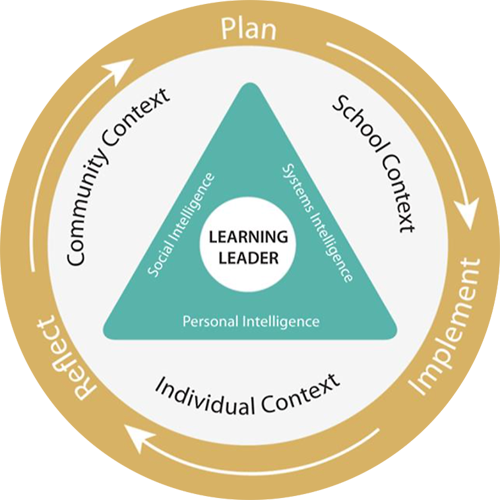
The first collective effort of the newly formed Collaborative was to create the original version of the School Leader Paradigm. It focused on what is now known as the Becoming side of the Paradigm, identifying the professional intelligences, competencies, and attributes needed by learning leaders. When conducting extensive research for this first iteration of the Paradigm, the intelligences were missing from other published frameworks, which focused on what is now known as the Doing side of the Paradigm, or the work of the learning leader.
Not long after the first version of the Paradigm was developed, other states joined the Collaborative's efforts to wrestle with critical questions to improve school leadership in our Nation's schools:
- How do we keep school leaders in their positions longer?
- How can we help school leaders accelerate the impact of their leadership?
- What attributes must school leaders possess in order to be reflective, servant-oriented, equity-minded, and student-centered?
- What essential behaviors must school leaders demonstrate in order to cultivate culture, build systems, and improve learning in their schools?
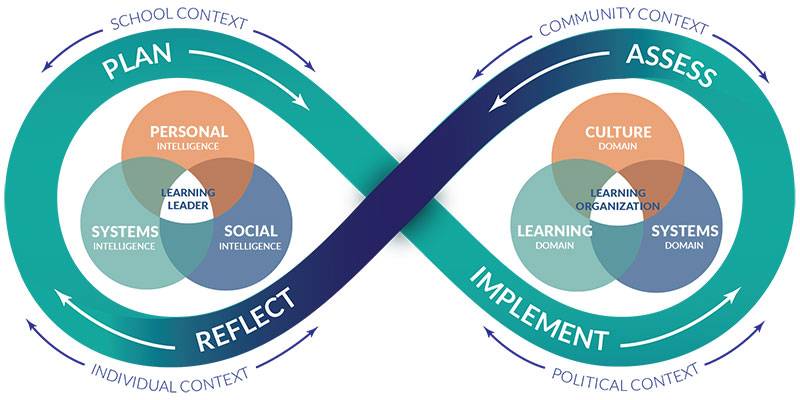
This effort led to the development of trainings, resources, and the second edition of the Paradigm, which was published in 2018. This version connected the becoming intelligences with the doing domains of the learning leader's job. The doing domains and dimensions were crafted after a review of existing work, including the Professional Standards for Educational Leaders (PSEL) and the National Association of Secondary School Principals' Building Ranks: A Comprehensive Framework for Effective School Leaders. Paradigm 2.0 also added context to the leader's work and demonstrated the continuous process that occurs while leaders grows in both their professional intelligences and their knowledge and skills of the dimensions needed to lead their organizations. This continuous process was brought to life through the introduction of a cycle of inquiry, which showed the infinite process of planning, implementing, assessing, and reflecting on the leader's own professional growth as well as that of the organization.
Since 2018, the Collaborative has continued to grow and the Paradigm has continued to evolve. Today, 20 principals' associations from 18 states make up the National School Leader Collaborative. For the Paradigm, the members of the Collaborative conducted extensive research to define the essential behaviors and proficiency details needed to clarify the doing domains of the leader's work. This led to an updated Paradigm, or Paradigm 3.0. In addition to further fleshing out the doing side, Paradigm 3.0 offers a deeper look at the cycle of inquiry, providing essential questions and implementation strategies. Further, additional thought and understanding is offered for the critical contexts though which leaders operate: individual, school, community, and political.
With the foundation of a strong leadership framework and the unifying commitment to effectively serve school leaders, the National School Leader Collaborative has and continues to grow a vast ecosystem of supports, resources, and professional learning available to our Nation's school leaders. Visit each Collaborative members' websites to learn more.